home flickr
Your Ad Here

Sunday, September 09, 2007


HONG KONG (Reuters) - Archaeologists have published a new map showing an extensive ancient settlement surrounding Cambodia's Angkor Wat that supported large numbers of inhabitants before and after the famous temple was built.

Ancient urban sprawl surrounded Cambodia's Angkor

Now obscured by vegetation and low-lying clouds, the ruins spread over 1,000 sq km and were made up of thousands of houses, roads, manmade ponds and canals, researchers from Australia, Cambodia and France said in the latest issue of the Proceedings of the National Academy of Sciences.

"We now know that instead of being just (a collection of) temples, Angkor was actually a continuous and interconnected network of temples and small scale residential features like small village ponds, small village temples as well," Damien Evans of the Archaeological Computing Laboratory at the University of Sydney told Reuters in a telephone interview.

"Very little remains now, they are just piles of brick ... a thousand years ago (it) would have been a huge and popular city, full of life, rather than this image of temples in a jungle."

Angkor Wat was built in the early 12th century, while the settlement existed between 500 AD and 1500 AD, Evans said.

"What we can see, even on a preliminary basis, is that several hundred thousand people must have lived in the Angkor area ... which is defined by the infrastructure, the roads, the canals, huge embankments," he added.

Using hand-drawn maps, ground surveys, satellite imagery, aerial photography and ground-sensing radar provided by NASA, the researchers identified what they believed to be more than a thousand former manmade ponds, temples and moats -- all of which were now replaced by vegetation.

Ranging from 20 metres to 8 km long, the ponds were used for drinking, irrigation, livestock and other domestic purposes and were especially crucial for the dry season.

"The slightly lower elevations of the rice fields in the former moats and reservoirs ... result in different stages of rice maturity and in differential levels of soil moisture content, which strongly affect the returned radar signal," Evans said. "You get more mature rice in these wetter areas."

The researchers believe the settlement was abandoned around 1500 AD because of overexploitation and deforestation.

"What our work proved for the first time was that Angkor certainly was large enough and its water management system was complex and extensive enough to have created very serious environmental problems," Evans said.

"In such situations, infrastructure becomes very important and increasingly complex and difficult to maintain."

Future studies will look at how serious these problems were and if the inhabitants were able to deal with them.



Friday, September 07, 2007


I'm a Team Lead!

I've been made a Development team lead at work with 5 developers reporting to me.
Exciting, scary stuff.


Thursday, September 06, 2007


The long-outstanding Thailand post

P1040125

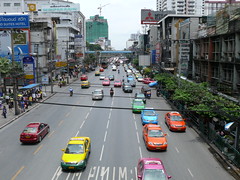
On the 18th August, my lovely girlfriend Pei Lin and I, and our friends Chris and Ronnie went on a week long jaunt around the tropical (and shopping) paradise known as Thailand.

P1040029

We stayed in Bangkok (thanks Trang Hotel!) for 3 nights, then flew to Phuket (staying at the lovely Deevana Patong) for a further 5 nights of relaxation, massage, cocktails & sunburn.

P1040235

We were meant to stay in Bangkok for four nights, but I stuffed up the flight booking, but anyway.

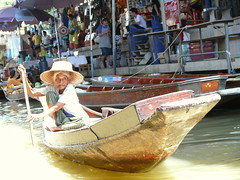
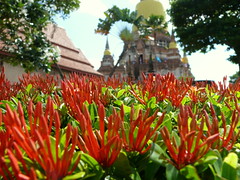
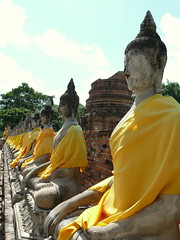
Thailand is gorgeous. We rode elephants, visited ancient cities and temples and of course shopped extensively. For me, the floating markets was a real highlight.

P1030989

Bangkok is crazy enough to be exciting, but relaxed and friendly enough to be thoroughly enjoyable. On the first day in Phuket Chris and I proved our already obvious manliness by getting royally sunburnt. Sunburnt feet and ankles sucks. Don't do it.

Luckily there was enough aloe vera gel and Mai Tai's available to successfully stem any discomfort. Well.. ok.. some discomfort. For me. Chris got TOASTED ;).

P1030857

Phuket was so relaxing. Pei Lin can now swim, which is awesome. The food was so fresh, and not as oily as I find it can be here in KL. I think I could eat the seafood fried rice from there for years without getting bored.

I also had a squid curry which was probably close to being the hottest thing I've eaten. It was like magma, seriously. Well, not seriously, but it was really, really hot.


A lovely place to holiday. I can't wait to get back there soon.


P1030844

Tuesday, September 04, 2007


Life of a Yakuza's Daughter


With her dyed-brown long hair and tight designer jeans, Shoko Tendo looks like any other stylish young Japanese woman - until she removes her shirt to reveal the vivid tattoos covering her back and most of her body.

The elaborate dragons, phoenixes and a medieval courtesan with one breast bared and a knife between her teeth are a symbol of Tendo's childhood as the daughter of a "yakuza" gangster and her youth as a drug-using gang member.

The author of Yakuza Moon, a best-selling memoir just out in English, the 39-year-old Tendo says that police efforts to eradicate the gangsters have merely made them harder to track.

"The more the police push, the more the yakuza are simply going underground, making their activities harder to follow than they ever were before," she said.

Police say full-fledged membership in yakuza groups fell to 41,500 last year, down from 43,000 in 2005, a decline they attribute to tighter laws against organised crime.

The number of yakuza hangers-on, including thugs and members of motorcycle gangs, who are willing to do their dirty work, though, rose marginally to 43,200.

More shocking for many in Japan, where gun-related crime is rare, were a handful of fatal shootings by yakuza earlier this year, including the killing of the mayor of Nagasaki.

Tendo said the shootings were a result of the legal crackdown on yakuza, which has made it harder for them to ply their traditional trades of prostitution, drugs and bid-rigging.

"They're being forced into a corner, their humanity taken away," she said. "All the things they used to do for a living have been made illegal, so life has become very hard."

Experts say this is especially true for gangsters in less affluent parts of Japan, a reflection of the same sort of income gaps that increasingly plague the nation as a whole.

"Yakuza need a lot of money, but depending on where they are, business isn't going so well," said Nobuo Komiya, a criminology professor at Tokyo's Rissho University. "So they turn to guns."

Descended from medieval gamblers and outlaws, yakuza were long portrayed as latter-day samurai, bound by traditions of honor and duty and living extravagant lives.

Tendo's father, the leader of a gang linked to the Yamaguchi-gumi, the largest yakuza group, led a "classic" yakuza life replete with Italian suits, imported cars and a Harley-Davidson motorcycle.

Raised with strict ideas of honour, she was both spoiled and scolded by the tattooed men who frequented her family home.

But she also faced prejudice and bullying because of her father. In response, she joined a gang, took drugs and become the lover of several gangsters before near-fatal beatings and drug overdoses convinced her to change her life.

Now a writer and mother, Tendo has distanced herself from the yakuza world, which she feels is rapidly losing its traditions.

Being a gang member is not illegal in Japan, and until recently the gangs were known for openness. Their offices even posted signs with their names and membership lists inside.

Gangs cooperated with police, handing over suspects in return for police turning a blind eye to yakuza misdemeanors, but this broke down after organized crime laws were toughened in 1992.

The largest part of yakuza income now comes from pursuits involving stocks, property and finance.

"What we're going to see from here on is the yakuza becoming more structured, like the US Mafia, and dividing itself between business experts and violence experts," said Manabu Miyazaki, a writer whose father was also a yakuza.

"As the world becomes more borderless, they'll need experts who can deal with this too, speaking Chinese and English."

Like Japan as a whole, gangsters are also ageing, and fewer young people look to organized crime as a career option.

Police figures showed fewer than 20 per cent of yakuza were in their 20s in 2005, a trend both Tendo and Miyazaki attributed to young people's dislike for the tough life involved.

"They think being a yakuza is like joining a company," Miyazaki said. "There's a joke about a young man going to a gang office and asking what the salary was, and would he get insurance."

But while today's yakuza are eschewing tattoos and amputated fingers - cut off to atone for mistakes - in favour of more mainstream lifestyles, they are unlikely to disappear altogether.

"Fewer people want to become yakuza," Miyazaki said. "But those who do will be very logical, very scary - and much, much more dangerous."

Monday, September 03, 2007


A different Cuckoo Clock


The traditional Black Forrest Cuckoo Clock is creatively crucified by German artist and product designer, Michael Sans. This clock, simply titled "Cuckoo Clock", with materials consisting of; digital clock, metal housing, chromed nails and chain, cuckoo (died of natural causes in 1958). One of a kind-Not for sale.

Odd Search