home flickr
Your Ad Here

Monday, October 27, 2008


The Oracle concept watches by Designer Andy Kurovets mixes time with Chinese philosophy.
The philosophy in particular is I Ching and it is a symbol system used to identify order in chance events. You can read about it more over here.

Andy adds a hexagram generator into the watch so that you can generate your own future. It is rather 'confusion' and would require an understanding of I Ching.

Thursday, October 23, 2008


Electric cars 'just four years away'


Within just four years, most Australians will be able to drive an electric car and recharge it at special plug-in points at home, the office or shopping centres.

The mass use of electric cars moved a giant step closer to reality on Thursday, with power company AGL and finance group Macquarie Capital signing an agreement with international group Better Place to provide infrastructure to support the environmentally-friendly vehicles.

Under the agreement, Macquarie will raise $1 billion to build an electric-vehicle network in Melbourne, Sydney and Brisbane, and AGL will power it with renewable energy.

Better Place, established by American entrepreneur Shai Agassi, has designed the infrastructure model, which is already being rolled out in Israel and Denmark.

Mr Agassi said under the agreement, by 2012 the three major Australian cities will each have a network of between 200,000 and 250,000 charge stations where drivers can recharge their electric cars.

These are likely to be at home, in businesses, car parks and shopping centres, he said.

In addition, there will be some 150 switch stations in each city and on major freeways, where electric batteries can be automatically replaced in drive-in stations similar to a car wash.

"We call it a ubiquitous charging network across the cities," Mr Agassi said in Melbourne.

"It's a massive infrastructure project ... and that means new jobs for Australians."

Drivers will pay to recharge their cars through various power supply agreements, similar to mobile phone contracts, where consumers choose the rate that best reflects their car use.

Mr Agassi said the deal was an integral step, as people would only buy electric vehicles if the infrastructure was in place to support them.

While Renault-Nissan is already manufacturing an electric-only car, Mr Agassi said he hoped the agreement would encourage Australia's car manufacturers to develop their own versions.

The Victorian government has established a working group to examine fuel-efficient vehicle technology with the state's car manufacturers, with a particular focus on developing the first generation of electric vehicles.

"The Victorian government supports any initiative that will have positive outcomes in reducing emissions in the transport sector and I welcome this innovative approach to help make broad adoption of electric vehicles in Australia possible," Premier John Brumby said.

Better Place is also in discussion with federal and local governments about the rollout of the infrastructure.

Head of global development, Marshall Towe, said they hoped to strike an agreement that allowed them to install their infrastructure across the country without having to seek permission from each local area, similar to the deployment of the national cable network by Telstra.

Mr Agassi said it was up to Australian governments to determine how they would encourage consumers to turn to electric cars, such as through tax incentives or free power for the first purchasers.

"It's more a question for the government for how quickly they want the tipping point (towards electric cars) to happen," he said.

"Every government decides what they want to do. We believe that Australia, looking at all the alternatives, will pick the right mix for Australia."

Mr Agassi said they would look at introducing the infrastructure in Adelaide and Perth after 2012.

Wednesday, October 22, 2008


India launches moon mission in Asian space race


Scientists have better maps of distant Mars than the moon where astronauts have walked. But India hopes to change that with its first lunar mission.

Chandrayaan-1 - which means "Moon Craft" in ancient Sanskrit - launched from the Sriharikota space centre in southern India early Wednesday morning in a two-year mission aimed at laying the groundwork for further Indian space expeditions.

Chief among the mission's goals is mapping not only the surface of the moon, but what lies beneath. India joined what's shaping up as a 21st century space race with Chinese and Japanese crafts already in orbit around the moon.

The United States, which won the 1960s race to send men to the moon, won't jump in this race with its new lunar probe until next spring, but it is providing key mapping equipment for India's mission.

As India's economy has boomed in recent years, it has sought to convert its new found wealth - built on its high-tech sector - into political and military clout and stake a claim as a world leader. It is hoping that a moon mission - coming just months after it finalized a deal with the United States that recognizes India as a nuclear power - will further enhance that status.

"It is a remarkable technological achievement for the country," said S. Satish, a spokesman for the Indian Space Research Organization, which plans to use the 3080-pound (1723-kilogram) lunar probe to create a high-resolution map of the lunar surface and what minerals are below. Two of the mapping instruments are a joint project with NASA.

Until now, India's space launches have been more practical, with weather warning satellites and communication systems, said former NASA associate administrator Scott Pace, director of space policy at the George Washington University.

"You're seeing India lifting its sights," Pace said.

To date only the US, Russia, the European Space Agency, Japan and China have sent missions to the moon.

While much of the technology involved in reaching the moon has not changed since the Soviet Union and the U.S. did it more than 4 decades ago, analysts say current mapping equipment allows the exploration of new areas, including below the surface.

In the last year, Asian nations have taken the lead in exploring the moon. In October 2007, Japan sent up the Kaguya spacecraft. A month later, China's Chang'e-1 entered lunar orbit.

Those missions took high resolution pictures of the moon, but aren't as comprehensive as Chandrayaan-1 will be or NASA's upcoming half-a-billion-dollar Lunar Reconnaissance Orbiter, Pace said. The most comprehensive maps of the moon were made about 40 years ago during the Apollo era, he said.

"We don't really have really good modern maps of the moon with modern instrument," Pace said. "The quality of the Martian maps, I would make a general argument, is superior to what we have of the moon."

NASA has put probes on Mars' frigid polar region, but not on the rugged poles of the moon. Yet the moon's south pole is where NASA is considering setting up an eventual human-staffed lunar outpost, Pace said.

The moon's south pole is "certainly more rugged than where Neil Armstrong landed. It's more interesting. It's more dangerous," Pace said. "We need better maps."

And while the moon race in the 1960s was a two-country sprint between the United States and the USSR, more countries are involved this time. China, in particular, has been forging ahead in space.

Beijing sent shock waves through the region in 2003, when it became the first Asian country to put its own astronauts into space. It followed that last month with its first spacewalk.

More ominously, last year China also blasted an old satellite into oblivion with a land-based anti-satellite missile, the first such test ever conducted by any nation, including the United States and Russia.

While this is India's first space expedition beyond Earth's orbit, the head of India's space agency believes it can quickly catch China, its rival for Asian leadership.

"Compared to China, we are better off in many areas," Indian Space Research Organization chairman G. Madhavan Nair said in an interview with India's Outlook magazine this week, citing India's advanced communication satellites and launch abilities.

India lags behind only because it has chosen not to focus on the more expensive manned space missions, he said. "But given the funds and necessary approvals we can easily catch up with our neighbor in this area."

The mission is not all about rivalry and prestige. Analysts say India stands to reap valuable rewards from the technology it develops and, according to Pace, it already shows increased confidence in difficult engineering and quality control.

"Each nation is doing its own thing to drive its research technology for the well-being of that nation," said Charles Vick, a space analyst for the Washington think tank GlobalSecurity.org.

"Traditionally, for every dollar put into space research, we get that much more back," he said.

India is also collaborating closely with other countries on the mission.

Of the 11 instruments carried by the satellite, five are Indian, three are from the European Space Agency, two from the US - including radar that can search for ice under lunar poles - and one from Bulgaria.

Beyond 3-D mapping the moon and scanning for mineral deposits, the $US80 million ($117 million) mission will test systems for a future moon landing, the Indian space agency said.

India plans to follow this mission with landing a rover on the moon in 2011 and eventually a manned space program, though this has not been authorised yet.

And the Indian space agency was already dreaming of more.

"Space is the frontier for mankind in the future. If we want to go beyond the moon, we have to go there first," said Satish.


London's buses go to hell

LONDON: Buses emblazoned with advertisements declaring "there's probably no God" will soon be travelling through the streets of London after the prominent atheist Professor Richard Dawkins agreed to help pay for them.

Campaigners say the messages will provide a "reassuring" antidote to religious ads that "threaten eternal damnation".

Professor Dawkins, the author of The God Delusion, said: "Religion is accustomed to getting a free ride - automatic tax breaks, unearned 'respect' and the right not to be 'offended', the right to brainwash children.

"Even on the buses, nobody thinks twice when they see a religious slogan plastered across the side. This campaign to put alternative slogans on London buses will make people think - and thinking is anathema to religion."

The advertising campaign, which could be plastered across as many as 60 buses for a month if just £11,000 ($27,000) is raised, was triggered by a blog posting. Those behind the project are confident they will raise enough money to pay for two sets of 30 bendy buses to travel through the capital in January bearing the atheist slogan: "There's probably no God. Now stop worrying and enjoy your life."

Melaka (Malacca)


The site where the city of Malacca stands today was the center of Malaccan history.
It was the capital of the Malaccan Sultanate and was the centre of the Malay world in the 15th and the 16th century after the Malays moved over from Sumatra and it was the most developed part of the Malay Peninsula before it fell to the Portuguese in 1511.

Centuries of colonization by the Portuguese, Dutch and the British as well as development of Straits Chinese (Peranakan) culture have influenced the architecture of the town.

.. And we went there recently for a couple of days :).


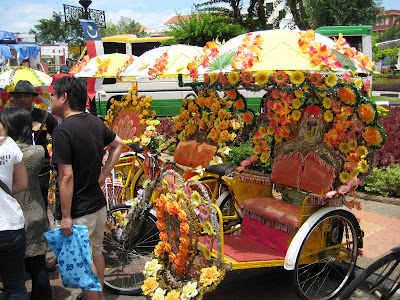
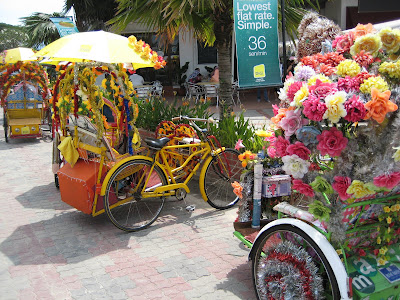
The trishaws are a great way of seeing the town, and not really that expensive either.


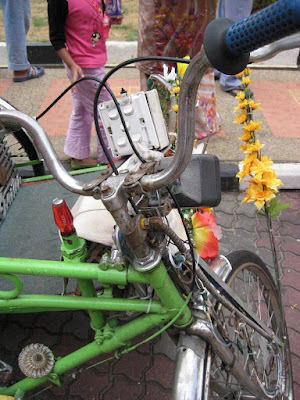
Some of the wiring on these things is incredible.. check the above, those are interior light switches. Most, if not all of the trishaws has a car battery or similar in the back that they use to power the pounding music (a mishmash of pounding techno and 80's love songs) and this here is the control centre of it all.


You can see a different (and probably safer) configuration above.


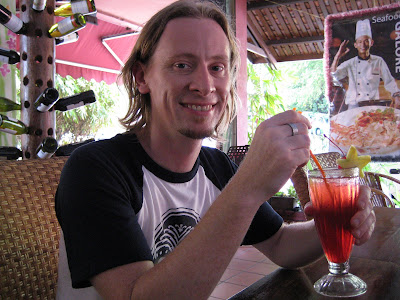
It was really hot, so we treated ourselves to a couple of cocktails before lunch. I'm liking Singapore Slings very much. I had a few of them, just to make sure.


Pei Lin enjoys 'Sex on the beach' .. ehehehe.


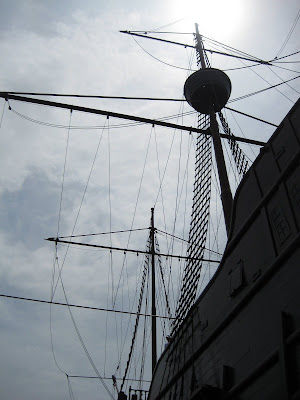
Replica Portuguese ship. Interesting 6/10; refuge from the heat 9.5/10.


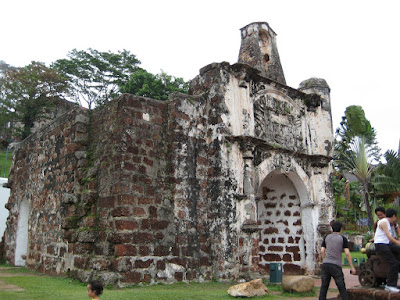
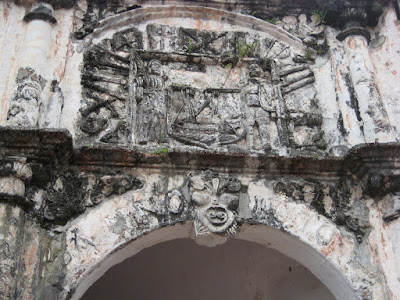
A' Formosa - built by the Portuguese in 1511 as a fortress to safeguard their settlement


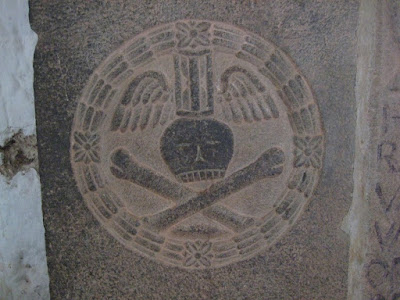
Skull & cross bones on dutch(?) grave stones


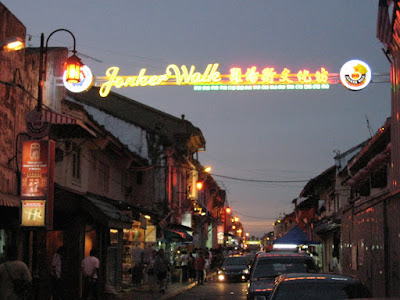
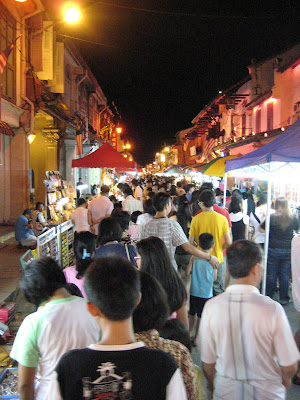
Night Markets on Jonkers Street


View from a tri-shaw


Oh course, how could we not have the famous Malaccan Chicken Rice ball.

All in all, Malacca is an excellent way to escape from KL for a couple of days. Great food, friendly people, and more sights, sounds and novelties that you can poke the proverbial stick at.

High recommended. In fact, I'm going to go back soon.


Odd Search