home flickr
Your Ad Here
Showing posts with label Singapore. Show all posts

Wednesday, October 01, 2008

Mick visits KL


A couple of weeks ago, my good pal Mick ventured forth from the golden shores of Australia and graced us with his presence in KL. As it was his first trip here, we did our share of the tourist circuit, such as:


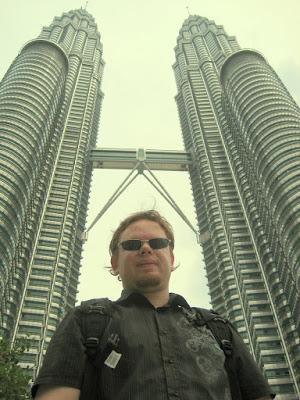
having our photos taken outside KLCC,


going to the Batu caves,


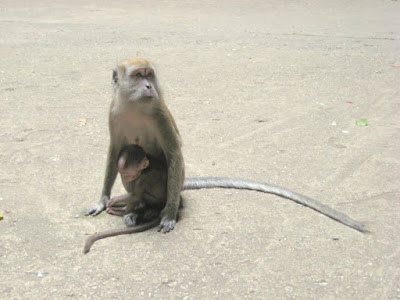
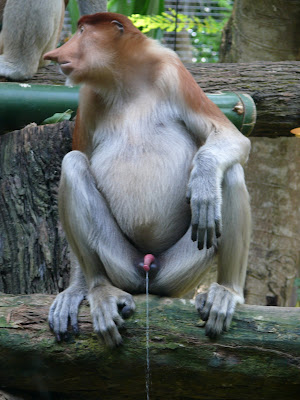
.. and taking photos of the monkeys


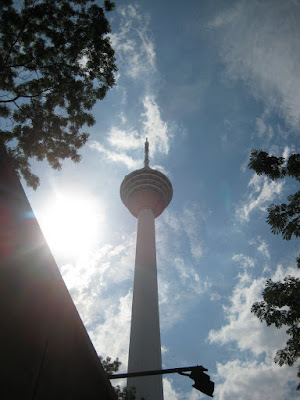
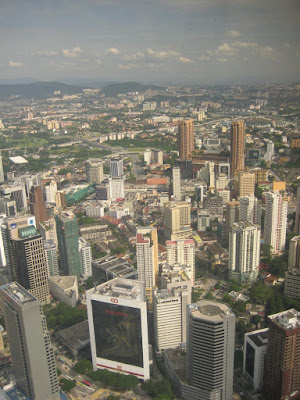
going up KL tower,


taking photos from the top,


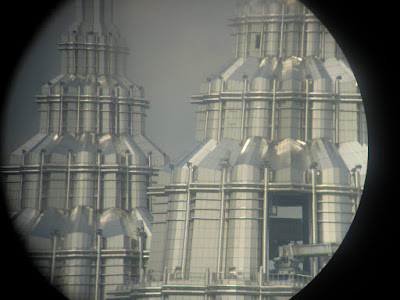
.. I discovered that if I held my camera just right, I could take photos through the telescopes they have up there. The view was amazing..


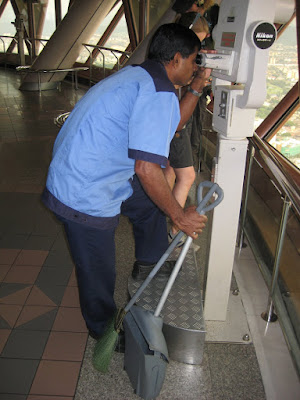
.. even the staff think so!


after checking out a few more of the sites of KL, we flew down to..


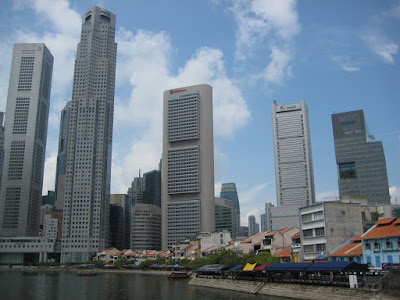
err...Singapore!


.. still more Singapore


.. that's right, you got it, Singapore


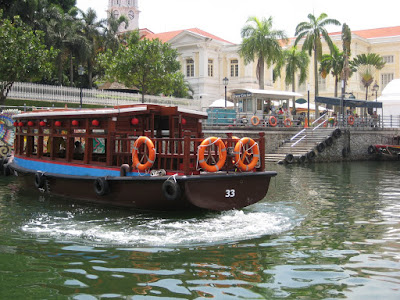
We caught boats..


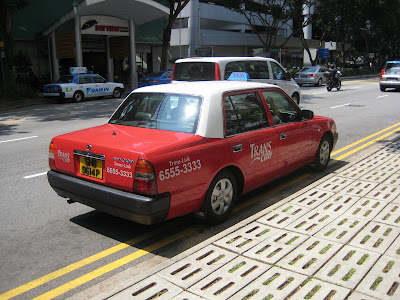
.. and taxi's


.. we went to the zoo


.. and saw the animals..


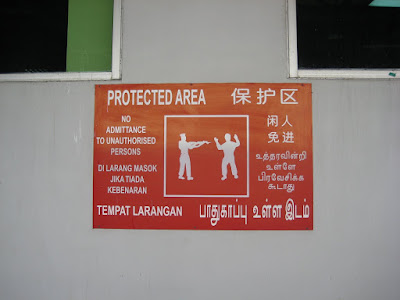
.. we didn't even get shot.


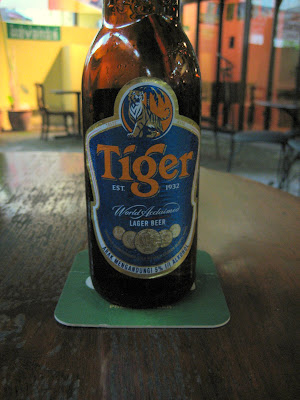
.. so we drank some beer.


Wednesday, July 09, 2008


How English Is Evolving Into a Language We May Not Even Understand


The targeted offenses: if you are stolen, call the police at once. please omnivorously put the waste in garbage can. deformed man lavatory. For the past 18 months, teams of language police have been scouring Beijing on a mission to wipe out all such traces of bad English signage before the Olympics come to town in August. They're the type of goofy transgressions that we in the English homelands love to poke fun at, devoting entire Web sites to so-called Chinglish. (By the way, that last phrase means "handicapped bathroom.")

But what if these sentences aren't really bad English? What if they are evidence that the English language is happily leading an alternative lifestyle without us?

Thanks to globalization, the Allied victories in World War II, and American leadership in science and technology, English has become so successful across the world that it's escaping the boundaries of what we think it should be. In part, this is because there are fewer of us: By 2020, native speakers will make up only 15 percent of the estimated 2 billion people who will be using or learning the language. Already, most conversations in English are between nonnative speakers who use it as a lingua franca.

In China, this sort of free-form adoption of English is helped along by a shortage of native English-speaking teachers, who are hard to keep happy in rural areas for long stretches of time. An estimated 300 million Chinese — roughly equivalent to the total US population — read and write English but don't get enough quality spoken practice. The likely consequence of all this? In the future, more and more spoken English will sound increasingly like Chinese.

It's not merely that English will be salted with Chinese vocabulary for local cuisine, bon mots, and curses or that speakers will peel off words from local dialects. The Chinese and other Asians already pronounce English differently — in both subtle and not-so-subtle ways. For example, in various parts of the region they tend not to turn vowels in unstressed syllables into neutral vowels. Instead of "har-muh-nee," it's "har-moh-nee." And the sounds that begin words like this and thing are often enunciated as the letters f, v, t, or d. In Singaporean English (known as Singlish), think is pronounced "tink," and theories is "tee-oh-rees."

English will become more like Chinese in other ways, too. Some grammatical appendages unique to English (such as adding do or did to questions) will drop away, and our practice of not turning certain nouns into plurals will be ignored. Expect to be asked: "How many informations can your flash drive hold?" In Mandarin, Cantonese, and other tongues, sentences don't require subjects, which leads to phrases like this: "Our goalie not here yet, so give chance, can or not?"

One noted feature of Singlish is the use of words like ah, lah, or wah at the end of a sentence to indicate a question or get a listener to agree with you. They're each pronounced with tone — the linguistic feature that gives spoken Mandarin its musical quality — adding a specific pitch to words to alter their meaning. (If you say "xin" with an even tone, it means "heart"; with a descending tone it means "honest.") According to linguists, such words may introduce tone into other Asian-English hybrids.

Given the number of people involved, Chinglish is destined to take on a life of its own. Advertisers will play with it, as they already do in Taiwan. It will be celebrated as a form of cultural identity, as the Hong Kong Museum of Art did in a Chinglish exhibition last year. It will be used widely online and in movies, music, games, and books, as it is in Singapore. Someday, it may even be taught in schools. Ultimately, it's not that speakers will slide along a continuum, with "proper" language at one end and local English dialects on the other, as in countries where creoles are spoken. Nor will Chinglish replace native languages, as creoles sometimes do. It's that Chinglish will be just as proper as any other English on the planet.

And it's possible Chinglish will be more efficient than our version, doing away with word endings and the articles a, an, and the. After all, if you can figure out "Environmental sanitation needs your conserve," maybe conservation isn't so necessary.

Any language is constantly evolving, so it's not surprising that English, transplanted to new soil, is bearing unusual fruit. Nor is it unique that a language, spread so far from its homelands, would begin to fracture. The obvious comparison is to Latin, which broke into mutually distinct languages over hundreds of years — French, Italian, Spanish, Portuguese, Romanian. A less familiar example is Arabic: The speakers of its myriad dialects are connected through the written language of the Koran and, more recently, through the homogenized Arabic of Al Jazeera. But what's happening to English may be its own thing: It's mingling with so many more local languages than Latin ever did, that it's on a path toward a global tongue — what's coming to be known as Panglish. Soon, when Americans travel abroad, one of the languages they'll have to learn may be their own.


.. from wired


Tuesday, June 26, 2007


.. a weekend in Singapore ..

P1030185

Well, it was a bit of a whirlwind trip, but our weekend in Singapore was awesome fun. We arrived by Aeroline bus at about 1am and one of the efficient friendly and super clean Toyota Crown's that form the majority of Singapore's taxi fleet quickly whisked us away to Geyland, where our (small & cheap) hotel was.

P1030164

The room was small, but functional, and we didn't really care as we were only spending an hour or so either side of sleep there anyway. The neighbours were friendly too, seemingly our street being entirely populated by Singapore's lovely (and not quite so lovely) ladies of the night.

Actually, 'ladies of the night' is not quite the correct term because Saturday morning, 10am there were a couple of enthusiastic proponents peppering the footpath, with umbrella's to protect against the sun, of course. I'm not sure who exactly is looking to secure the company of a call-girl after (or before!) a Saturday breakfast, but hey, when in rome, something something something.

As we were going to be leaving at 2:30pm the next day, we knew we didn't have too much time on our hands, so after a casual sleep in we hit the road, first stop: Sentosa island and the aquarium. We caught the cable car from the Harbour front across to the island, which was actually a lot quicker journey than I expected it to be.

P1030299

Before I go on, one thing I noticed about Singapore was that it seemed a reasonable amount hotter and less humid than KL. I'm not sure if that's a regular thing or just happened to be this weekend, but I can say that I deeply regretted wearing jeans on that first day. I was driven so mad by the heat that I was forced to purchase a solar powered fan-hat. Worth every cent, even though it barely works.

P1030265

Anyway, so where was I? Aah yes, Sentosa, ok, so we made our way to the Aquarium which was thankfully largely underground. Actually enjoyed the aquarium more than I thought I would, and I was expecting it to be pretty good. A really nice collection of exhibits with very little along the boring model of sea animals line.

Highlights: surprisingly, perhaps the jellyfish.

P1030250

Ok, so cable car back to the 'mainland' of Singapore, can't remember what we did for lunch, but not long after this alleged meal, we headed north, via taxi, to the zoo.

P1030354

Singapore zoo is often spoken about in hushed tones amongst the zoological fans, and with good reason. This is a great zoo. We unfortunately only had about 90 minutes to see what was recommended to take twice as long, but I think we made a good go of it. Amazing place, can't wait to go back and do it all again.

P1030411

Highlights: the Orangutan's? The huge crocs? Oh don't make me choose.
Lowlights: perhaps we were a bit late and some of the attractions had gone for a lie down.

This is not one of them, this is a worker sleeping in the back of a moving truck on the highway:

P1030330


Dinner was a great wanton noodle soup (Peilin, please help, what was it called again?) and then completely unnecessarily followed by satay sticks. In my rush to get out of work on Friday I forgot the print the details of where we were actually catching our return bus from the next day, so probably the next hour was spent hunting down an internet cafe so I could check. Thanks Chills Cafe, job well done in true Singaporean style... clean, quiet, minimum fuss.

P1030427

Taxi back to the hotel (Peilin remarking that maybe one of the ladies was going swimming because she was wearing a bikini top). Aaah sleep, sleep, glorious sleep.
Sunday morning, another sleep in, then over to east coast park for a nice bike ride along the water then lunch at somewhere exotic..Burger King.

P1030501

Just quickly, on the topic of taxis.. the whole scale of economics is a bit different here in KL, and taxi rides are often laughably cheap, even paying the gwei-lo rates. Singapore is much closer to Sydney in terms of exchange rate and prices, yet still the taxi's cost about $S15 for 20 minute trip. And we're talking a really nice taxi experience here too. Why are Australian taxi's so damn expensive per km?

P1030306

Hmmm... Anyways... After lunch back into the Harbourside again, a nice amount of time wandering around 'Candy Empire' (we spent how much in there?) Then back on the bus to return to KL. Phew. I think that's got it all.

I will miss the long, rolling green avenues of you Singapore, and your clean, organised ways. .. ...But we shall meet again.


Odd Search